About the Island
One Island, Layers of Memory
Darin and Tarout Island lies within Qatif Governorate in the Eastern Province, forming one of the richest cultural and coastal environments in the Arabian Gulf. Tarout has been associated with human settlement since the fifth millennium BCE, and its castle, the Al-Dira quarter, and the surrounding archaeological sites bear witness to successive civilizations and trade routes. Darin, meanwhile, takes its name from the harbor and maritime markets that once received musk, perfumes, textiles, and spices, alongside a culture of fishing, diving, and pearling.
The island's heritage is not confined to its buildings; it lives on in the dialect and memory of its people, and in its boats, crafts, markets, farms, and occasions. The development plan therefore treats both tangible and intangible heritage as a foundation for cultural and tourism development, not merely a backdrop for projects.
The Nature That Shapes the Place
Darin and Tarout Island features a coastline stretching approximately 22 kilometers, along with mangrove habitats, seagrass beds, intertidal zones, and farmland sensitive to urban expansion. This environment plays a role in protecting the coast, supporting biodiversity and fish stocks, and enhancing the natural landscape. The plan proposes restoring habitats, expanding the mangroves, protecting agricultural land, and connecting it to educational trails and low-impact ecotourism.
Community and Economy
The island's economy today relies on trade, services, small-scale hospitality, maritime activities, and traditional industries. The plan identifies opportunities to diversify this economy through ecological and cultural tourism, creative industries, waterfront development, specialized hospitality, and sports and water activities — while preserving the role of fishermen, farmers, craftspeople, and local businesses.
Three Landmarks That Tell the Island's History
Tarout Castle: A Landmark Atop a Hill Where Civilizations Succeeded One Another
Tarout Castle sits atop an archaeological hill at the heart of the historic town. The site's value is not limited to its defensive architecture; the hill itself holds layers of settlement spanning more than five thousand years, and archaeological finds and studies reveal the island's connections to Gulf civilizations and ancient trade routes. The development direction proposes restoring the castle and the surrounding Al-Dira houses, improving access and public space, and connecting the site to a living cultural trail that includes crafts, arts, and historical storytelling.
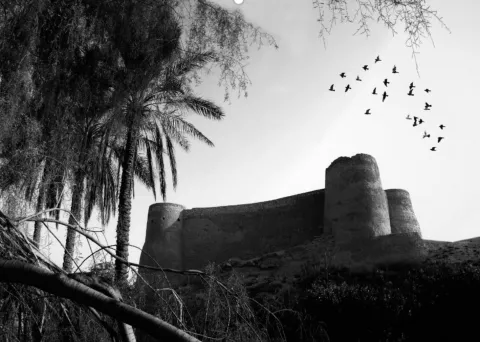
Tarout Castle — an archival photo documenting the castle within its natural and historic urban setting. | Source: Heritage Commission, "Texts on Tarout Castle," 2026; image from the Aramco archive as cited in the reference.
Al-Fayhani Palace: A Memory of Water, Pearls, and Trade
Water resources drew settlement to Darin, and the pearl trade later cemented its position as a stop for sailors and merchants along the Arabian Gulf. In 1886, the palace was inhabited by Mohammed bin Abdulwahab Al-Fayhani, one of the most prominent pearl merchants associated with the region's flourishing maritime trade. The site is presented today as an anchor for a heritage trail combining restoration, cultural interpretation, small-scale hospitality, cafes, exhibitions, and crafts, while preserving the authenticity of the building and its surroundings.
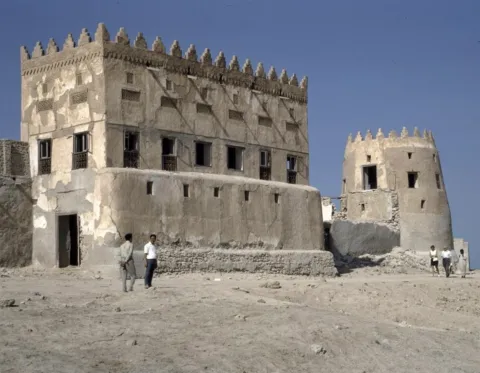
Al-Fayhani Palace — an archival photo of the palace before modern urban changes, showing its architectural details and towers. | Source: Heritage Commission, "Content and Texts on Al-Fayhani Palace," 2026; image from the Aramco archive as cited in the reference.
Darin Airport: From an Air Gateway to a Museum and Park
The Darin Airport site stands as a witness to an early era of aviation and connectivity in the Kingdom. The development direction proposes repurposing the site as an aviation museum and a coastal public park, including museum exhibits, educational programs, events, and visitor services, while preserving the remaining historical elements and presenting them within a clear spatial experience.
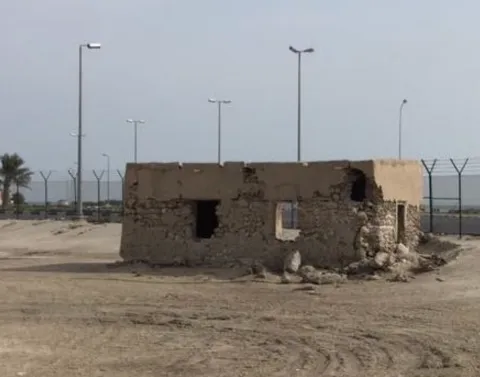
The historic Darin Airport site — field documentation of one of the remaining buildings at the airport site, used to highlight the value of preservation and adaptive reuse. | Source: Heritage Commission, "Texts on the Darin Airport Site," 2026.
Last updated: 17/09/2026 - 3:49 PM Saudi Arabia time
0 users said yes from 0 responses